WIC Program Eligibility 2026: Do You Qualify?
Advertising
WIC program eligibility is your gateway to free food, nutrition support, and health resources.
If you’re pregnant, breastfeeding, or raising a young child, you could qualify right now in 2026.
Read through the 4 federal criteria below and see exactly where your family stands.
See Also
- WIC eligibility requirements: the 4 criteria explained
- How to enroll your child in Head Start preschool
- How to apply for Section 8 housing assistance
- LIHEAP: get help paying your energy bills
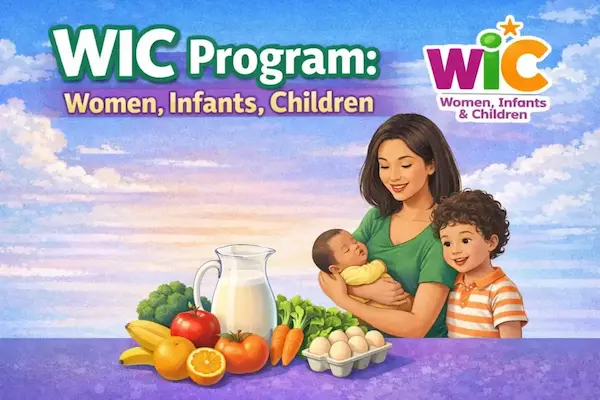
What Is WIC and Who Is the Program Designed For?
The Special Supplemental Nutrition Program for Women, Infants, and Children (WIC) is a federally funded initiative administered by the USDA Food and Nutrition Service.
Rather than serving the general population, WIC focuses precisely on the people most vulnerable to nutrition-related health setbacks: pregnant and postpartum women, breastfeeding mothers, infants, and young children up to age five.
The program provides four core benefits, all completely free:
- Monthly food benefits — loaded onto an eWIC card that works like a debit card at thousands of approved retailers and farmers’ markets. As of 2026, virtually every state has completed the transition to the eWIC card, replacing older paper vouchers for a faster, more discreet shopping experience.
- Personalized nutrition education — one-on-one counseling with trained professionals tailored to your family’s specific health needs and dietary goals.
- Breastfeeding support — from lactation consultants and peer counselors who can answer questions and help you navigate challenges at every stage.
- Healthcare referrals — connections to medical, dental, mental health, and social services that go beyond nutrition.
Understanding WIC program eligibility starts with four federal requirements that every applicant must meet.
All four must be satisfied — but as you’ll see, the criteria are broader and more inclusive than most people expect.
WIC Eligibility Requirement #1: Categorical Status
The first question is straightforward: does your situation fall into one of the groups WIC was specifically created to serve?
WIC who qualifies under the categorical requirement:
- Pregnant women — from the start of pregnancy through up to 6 weeks after birth or the end of the pregnancy.
- Postpartum women — up to 6 months after birth or the end of the pregnancy, whether or not you are breastfeeding.
- Breastfeeding women — through the infant’s first birthday, as long as breastfeeding continues.
- Infants — from birth up to their first birthday.
- Children — from age 1 up to their fifth birthday.
You don’t have to be the biological parent to apply for a child.
Fathers, grandparents, foster parents, and any other legal guardian can apply on behalf of an eligible infant or child — and doing so doesn’t affect the guardian’s own eligibility or income calculation for other programs.
WIC Program Eligibility Requirement #2: Income Guidelines for 2026
Meeting the WIC income guidelines is where many families assume they won’t qualify — but the threshold is higher than most people realize.
Your household’s gross income (before taxes and deductions) must be at or below 185% of the Federal Poverty Level (FPL).
The following WIC income limits are effective through June 30, 2026:
| Household Size | Annual Income | Monthly Income | Weekly Income |
|---|---|---|---|
| 1 Person | $28,953 | $2,413 | $557 |
| 2 Persons | $39,128 | $3,261 | $753 |
| 3 Persons | $49,303 | $4,109 | $949 |
| 4 Persons | $59,478 | $4,957 | $1,144 |
| 5 Persons | $69,653 | $5,805 | $1,340 |
| 6 Persons | $79,828 | $6,653 | $1,536 |
Your household size includes everyone you live with and share expenses with — including roommates, college students away at school, and military members on active duty elsewhere.
One rule that surprises many applicants: a pregnant woman counts as two people in the household size calculation — herself plus the unborn child.
For a twin pregnancy, that’s three.
This single adjustment can shift a family from “over the limit” to fully eligible, so always recalculate your household size correctly before drawing any conclusions about WIC qualifications.
Automatic Income Eligibility: Skip the Income Verification Step
If your household currently participates in any of the three programs below, you are automatically income-eligible for WIC — no pay stubs or tax returns required for that portion of your application:
- SNAP (Supplemental Nutrition Assistance Program)
- Medicaid
- TANF (Temporary Assistance for Needy Families)
This is known as categorical income eligibility, and it applies regardless of your actual earnings.
Your current award letter from any of these programs serves as proof — the WIC agency accepts it in place of income documentation and moves directly to the remaining steps in your application.
For families already enrolled in programs like Section 8 housing assistance, whose income is already verified and well within federal low-income thresholds, checking WIC eligibility is a logical next step that many overlook.
WIC Eligibility Requirement #3: State Residency
The residency requirement is simple: you must apply through a WIC agency in the state where you currently live.
If you move to a different state while receiving WIC, you’ll need to transfer your benefits to a local agency in your new state — but your participation in the program doesn’t stop during the transition.
Critically, WIC does not require U.S. citizenship.
The program does not ask about immigration status and does not report applicant information to immigration authorities.
In a mixed-status household, each family member’s eligibility is evaluated independently.
An undocumented parent can apply on behalf of a U.S.-born child, and that child’s WIC benefits are entirely separate from the parent’s status.
Receiving WIC benefits also does not count against applicants under public charge rules for immigration purposes, per USDA policy — a detail that is essential for mixed-status families to know.
WIC Eligibility Requirement #4: Nutrition Risk Screening
Every WIC applicant must be found to be at “nutritional risk” by a health professional at the WIC clinic before benefits can be issued.
In practice, this step is far less daunting than it sounds.
The screening is free, conducted at your first appointment, and takes only a few minutes.
The vast majority of applicants who meet the first three criteria will also satisfy this one — the risk categories are deliberately inclusive to reflect the real nutritional challenges facing low-income families.
Common factors that establish nutritional risk under 2026 WIC criteria:
- Medical conditions: Anemia (low iron levels), underweight or overweight status, a history of pregnancy complications, gestational diabetes, or any chronic condition that affects nutritional needs.
- Dietary patterns: Not meeting the Dietary Guidelines for Americans, limited variety in food intake, or inadequate consumption of fruits and vegetables — very common in food-insecure households.
- Predisposing factors: Being a young or first-time parent, having a high-risk pregnancy, experiencing food insecurity, or raising a child with a developmental delay or disability.
The purpose of this screening isn’t to create a barrier — it’s to help WIC staff understand your specific situation so they can assign a food package and education plan that genuinely fits your family’s needs.
WIC Household Income: How to Calculate It Correctly
Misunderstanding WIC household income rules is the most common reason eligible families talk themselves out of applying.
A few clarifications that matter:
- Always use gross income. WIC calculates eligibility before taxes and payroll deductions. Your take-home pay is lower than your gross income — but the income limits are set generously enough to account for this.
- Count everyone in the home. Household income for WIC includes all adults and children you live with and share finances with, even informally. College students away at school and active-duty military spouses still count.
- Factor in pregnancy correctly. Add one person to your household size for each unborn child. This is one of the most frequently missed adjustments in self-screening.
- Some income may be excluded. Certain military allowances such as Basic Allowance for Housing (BAH) may not count toward your WIC household income depending on your state’s agency. When in doubt, call your local WIC office before assuming you’re over the limit.
Your local WIC agency can run an informal pre-screening by phone or online before your formal appointment — a quick call can give you a clear answer without requiring any paperwork upfront.
2026 WIC Policy Updates That Affect Your Benefits
Beyond the core qualifications for WIC program participation, two significant policy changes are shaping the experience for new and returning participants in 2026.
Hybrid Appointment Options Are Now Permanent in Many States
During the pandemic, WIC expanded access through phone and video appointments for certain certifications and recertifications.
Many states have now made these options permanent — meaning you may not need to travel to a clinic for every appointment.
This matters most for families in rural areas, those without reliable transportation, and parents managing young children who find in-person visits difficult to schedule.
Check with your local agency to confirm which appointment types they currently support in your state.
The eWIC Card Has Replaced Paper Vouchers Nationwide
As of 2026, virtually every state has completed the transition to the eWIC card, which functions exactly like a debit card at participating grocery stores, supermarkets, and farmers’ markets.
The shift offers real advantages for participants:
- No more paper vouchers that expire or get lost
- More discreet checkout experience with no visible difference from a standard debit transaction
- Easier balance tracking through apps or online portals
- Expanded access at online pickup and delivery options at certain retailers
Families also receiving benefits like LIHEAP energy assistance will find that managing WIC benefits through the eWIC card follows a similarly streamlined process — a single card replacing what used to require paper documentation at every visit.
Who Does Not Qualify for WIC?
Understanding the requirements to qualify for WIC also means knowing the clear boundaries of the program.
You do not qualify for WIC if:
- You do not fall into one of the five categorical groups listed above
- Your household gross income exceeds 185% of the FPL and you do not receive SNAP, Medicaid, or TANF
- Your child has already turned five years old
- You do not reside in the state where you’re applying
Even if you don’t currently qualify, your eligibility can change quickly — a new pregnancy, a drop in income, a new child in your care, or enrollment in Medicaid can all make you eligible where you weren’t before.
WIC explicitly encourages families to re-check eligibility whenever their household situation changes.
This content is informational and independent. We have no affiliation, partnership, or control over the USDA, WIC agencies, or any third-party platforms referenced in this article.
Once you’ve confirmed your eligibility, the next step is learning how to apply and what benefits your specific food package will include. Our public assistance guides walk you through the full process and connect you with every program your family may be entitled to.