SNAP Benefits 2026: Who Qualifies and How to Apply Step by Step
SNAP benefits eligibility has real, specific rules — and millions of people who qualify never apply because the process feels confusing.
Advertising
In 2026, income limits, asset caps, and work requirements were updated, and knowing exactly where you stand takes less than ten minutes with the right information.
Keep reading and you will find a complete, step-by-step breakdown of who qualifies, how to apply, and what documents you actually need.
See Also
- Assurance Wireless free phone — what to know before applying
- Government phone companies — how to choose the right one
- Verizon Lifeline phone service — what to know
- QLink Wireless free phone — what to check first
What Is SNAP and Who Can Actually Qualify in 2026
SNAP — the Supplemental Nutrition Assistance Program — is a federal program that provides monthly funds on an EBT card to help low-income households cover the cost of groceries.
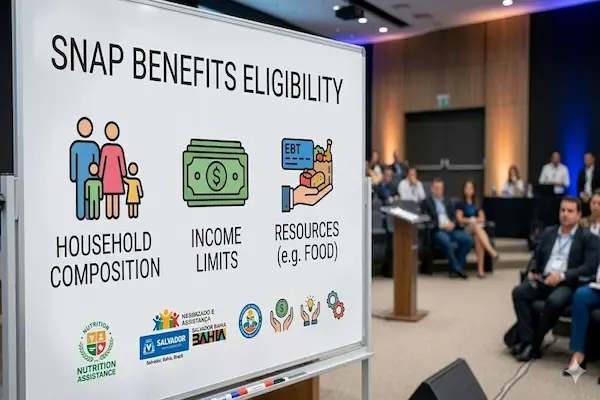
In fiscal year 2026 (October 1, 2025 through September 30, 2026), eligibility is determined by three main factors: household income, asset limits, and work requirements — all of which were updated this year with specific new thresholds.
Understanding the rules correctly matters because the program is managed at the state level, meaning the application portal, processing time, and some eligibility details vary depending on where you live.
The same low-income status that qualifies you for SNAP may also open access to other federal programs — including the government phone companies and Lifeline discounts available through the federal assistance system.
SNAP Benefits Eligibility 2026: Income Limits by Household Size
To qualify for SNAP benefits eligibility in 2026, most households must pass both a gross income test and a net income test.
Gross income is your total household income before any deductions. Net income is what remains after subtracting allowable deductions such as housing costs, childcare expenses, and medical costs for elderly or disabled members.
| Household Size | Gross Monthly Limit (130% FPL) | Net Monthly Limit (100% FPL) | Max Monthly Benefit |
|---|---|---|---|
| 1 | $1,696 | $1,305 | $298 |
| 2 | $2,292 | $1,763 | $546 |
| 3 | $2,888 | $2,221 | $785 |
| 4 | $3,483 | $2,680 | $994 |
| 5 | $4,079 | $3,138 | $1,183 |
| Each additional member | +$596 | +$459 | +$218 |
These are the standard food stamp income limits for the 48 contiguous states — limits are higher in Alaska and Hawaii.
Households that include a member aged 60 or older, or a person with a qualifying disability, may be subject only to the net income test, and some states allow gross income limits as high as 200% of the federal poverty level for these groups.
SNAP Family of 3 and Family of 4: What the Numbers Mean in Practice
For a SNAP family of 3, the gross monthly income limit is $2,888 — meaning a household earning up to that amount before deductions may qualify for up to $785 per month in benefits.
For a family of 4 income for food stamps, the gross ceiling rises to $3,483 per month, with a maximum benefit of $994 — nearly $12,000 per year in grocery assistance for a qualifying household.
These figures make it clear that SNAP serves working families, not just households with no income — the foodstamp income limit is specifically calibrated to the cost of living at the federal poverty threshold, not zero income.
SNAP Financial Requirements: Asset and Resource Limits in 2026
Beyond income, SNAP also evaluates countable resources — assets that could theoretically be used to cover food costs before federal assistance kicks in.
- Standard households: Countable assets must not exceed $3,000. This includes cash on hand, bank balances, and certain vehicles.
- Elderly or disabled households: The asset limit increases to $4,500 to reflect the higher costs and reduced earning capacity these households typically face.
- Exempt assets: Your primary residence does not count toward the limit. In most states, your primary vehicle is also exempt — a critical detail that prevents working families from being disqualified simply because they own a car to get to work.
The SNAP financial requirements are designed to target households with genuine need, not to penalize people for owning modest but necessary possessions.
SNAP Benefits Work Requirements in 2026: What Changed This Year
Work requirements are one of the most searched and most misunderstood aspects of SNAP benefits eligibility — and 2026 brought a significant update that affects more adults than ever before.
There are two separate sets of rules currently in effect, and which one applies to you depends on your age, family situation, and employment status.
General Work Rules (Ages 16–59)
If you are able to work and fall between 16 and 59 years old, you must register for work, accept any suitable job offer presented to you, and not voluntarily quit or reduce your hours below 30 per week in order to maintain your SNAP eligibility.
ABAWD Rules: The Biggest Change in 2026
Under the Fiscal Responsibility Act, the age ceiling for Able-Bodied Adults Without Dependents (ABAWDs) has been raised from 49 to 64 in 2026 — a major expansion that affects a significantly larger segment of the adult population.
If you are an ABAWD with no children under 18 in your household, the following rules now apply to you:
- You must work or participate in an approved work program for at least 80 hours per month.
- Failure to meet this requirement limits you to only 3 months of SNAP benefits in any 36-month period — commonly called the “3-Month Rule.”
- Exempt from ABAWD time limits: Veterans, unhoused individuals, and young adults aged 18–24 who were formerly in foster care are generally not subject to this restriction regardless of work status.
The SNAP benefits work requirements changes in 2026 make it more important than ever to document your employment, work program participation, or exemption status accurately when you apply or recertify.
SNAP Benefits for Students: The College Eligibility Rules
College students face the strictest eligibility rules within the SNAP system — and most students are surprised to learn they are generally excluded by default.
Students enrolled at least half-time at an institution of higher education are typically ineligible for SNAP benefits for students unless they meet at least one of the following exemptions:
- Working at least 20 hours per week at a paid job.
- Participating in a federally approved Work-Study program at their institution.
- Caring for a child under age 6, or a child under age 12 if adequate childcare is not available.
- Receiving TANF (Temporary Assistance for Needy Families) cash assistance benefits.
- Being physically or mentally unable to work at the required hours.
Students who qualify for SNAP often also qualify for the Lifeline Program for free or discounted phone service — which you can explore in our guide to Assurance Wireless free phone benefits for eligible households.
How to Apply for SNAP Benefits Step by Step in 2026
The application process is managed at the state level, but the general sequence is consistent across all 50 states.
- Use a pre-screening tool first. Platforms like mRelief, Propel, and your state’s Department of Human Services website all offer free eligibility screening tools. Running a quick check before starting the full application saves time and sets realistic expectations.
- Gather your documents. You will need proof of identity (driver’s license or state ID), proof of residency (utility bill or lease), proof of income for all household members (pay stubs, benefit letters), Social Security numbers for all household members applying, and documentation of any housing or childcare costs you plan to deduct.
- Submit your application. Most states now accept applications online through their official portals. Paper applications are available at your local Department of Social Services if you prefer or need an in-person option.
- Complete your interview. Most states require a brief eligibility interview, which can often be completed by phone. This typically takes 15 to 30 minutes and covers your household composition, income, and expenses.
- Receive your decision. Standard processing time is 30 days from the date of your application. If your household has very low income and urgent need, you may qualify for expedited benefits within 7 days.
SNAP Calculator and Link Card Eligibility: Quick Tools to Use Today
Before submitting a full application, using a SNAP calculator gives you a reliable estimate of your likely benefit amount based on your household size, income, and deductions.
The official USDA website and tools like Propel’s benefits screener are the most accurate free options — both use the current FY2026 SNAP guidelines and income thresholds to generate a realistic estimate.
For households in Illinois, a link card eligibility check can be done directly through the ABE (Application for Benefits Eligibility) portal, which handles SNAP, Medicaid, and cash assistance applications simultaneously in a single submission.
This content is purely informational. We have no affiliation with, sponsorship from, or control over any government agency, state program, or third-party platform mentioned here. Eligibility rules vary by state and are subject to change. Always verify your specific eligibility directly with your state’s Department of Human Services before applying.
Looking for more guides on federal assistance programs available to you? Our Public Assistance section covers SNAP, phone programs, internet subsidies, and every major benefit worth knowing about in 2026.